
Research Article · Volume 5, Issue 3 (2026) · pp. 326–334
Threatened Dialects, Fading Traditions: The Socio-Cultural Transformation of the Birhor Tribe of West Bengal
Rajib Kumar Guin1, Bidyarthi Dutta2
- 1Librarian, Central Library, Silda Chandrasekhar College (Vidyasagar University), Silda, Jhargram, West Bengal, INDIA.
- 2Department of Library and Information Science, Vidyasagar University, Rangamati, Midnapore, West Bengal, INDIA.
Abstract
The Birhor tribe has been classified as a Particularly Vulnerable Tribal Group (PVTG) and forms an indigenous tribal population that resides in the Purulia district of West Bengal with historical settlements in the states of Jharkhand and Odisha. Traditionally, being a semi-nomadic and forest-dependent community, the Birhor tribe has undergone substantial socio-economic and cultural transformations due to government-led rehabilitation programs. This study examines their shifting lifestyle, language, and cultural heritage, emphasizing the challenges they face in maintaining their identity. The research conducted through field surveys in multiple villages reveals the decline of their traditional occupations, such as ropemaking and monkey hunting, due to environmental and legal constraints. The Birhor language is critically endangered, lacking a written script and experiencing a decline in the number of native speakers. Some excerpts of the grammar and other linguistic aspects of Birhori language have been collected from the distinguished Birhor community people during the field survey. The older community members of this tribal group retain extensive knowledge about herbal medicine and indigenous traditions, while modernization and economic adversity threaten the transmission of this cultural wisdom. By documenting the tribe's linguistic and cultural practices, this paper highlights the urgent need for preservation efforts to safeguard their unique heritage from extinction.
Keywords: Birhor Tribe; Cultural Transformation; Birhori Language; Indigenous Language; Purulia; West Bengal; India; Socio-Cultural Data
FULL TEXT
INTRODUCTION
The Birhor tribal community settled down only in the Purulia district of West Bengal. They are considered one of the Particularly Vulnerable Tribal Groups (PVTGs) in West Bengal (Oraon, 2025). Scholars speculate that either a branch of the Mundas came to be known as the Birhor or a branch of the Birhor later adopted the name Mundas. Both groups were the original inhabitants of the hilly region of Chotanagpur. Birhor was a nomadic tribe with no permanent homes or villages (Risley, 1892). They roamed in groups from one end of the jungle to the other parts. Literally, the word "Birhor" means "people of the forest" (Gupta & Jagat, 2024). They were known as monkey catchers, sellers, and eaters. They are very fond of monkey flesh as a source of staple food. It is believed that they developed a skill in monkey hunting, utilizing a strong sense of scent, sight, and hearing (Premi, 2014). Generally, the Birhor communities are divided into two categories, i.e., 1) Uthlu, i.e., those who roam like nomads, and 2) Jaghi, i.e., those who live somewhere permanently (Baskey, 2006). Historically, the Birhor communities inhabited the forested and hilly terrains of Purulia, dwelling in traditional structures made from leaves, referred to as Kumba. Nonetheless, they have undergone a transition to a government-constructed housing system.
Initially, the relocation involved the provision of mud-built residences, which were subsequently supplanted by concrete huts developed by the Backward Classes Welfare Department of West Bengal. Until 1959, the Birhor community was excluded from all governmental development initiatives in West Bengal. Acknowledging the need for improvement in their socio-economic conditions, the government instituted a rehabilitation program tailored for Birhor families (Gorai et al., 2022). During the 1960s, a total of twenty Birhor families were allocated homesteads and residential structures under a centrally sponsored Sub Block initiative at Matiyala village, which was later designated as Bhupatipalli. The then minister of the Backward Classes Welfare Department, Mr. Bhupati Ranjan Majumder, was instrumental in the execution of this initiative (Ghosh & Chatterjee, 2024). In recognition of his contributions, the rehabilitation colony (Tanda) was subsequently renamed as Bhupatipalli. They are often known as Shikari, as hunting is their principal occupation, and they once preferred to eat the flesh of monkeys. Their traditional and primary occupation was rope making. They collect different types of bark from the stem, from which they make rope for various purposes. Since raw materials were not available, they had to change their occupation. Now, they work as daily laborers in agricultural fields or construction work. However, some of them are still engaged in the production of ropes. They are also engaged in hunting birds, collecting honey, and practicing herbal medicine (Rai, 2025). The Birhor communities are highly specialized in indigenous herbal medicine and are locally regarded as the most skilled herbalists (Sahu, 1995). The nature of their socio-economic and religious existence has been thoroughly determined by the triune combination of Nature (Vidyarthi, 1966). Their livelihoods are centered on and around the forest, as their everyday affairs and culture are deeply rooted therein (Banerjee & Imsong, 2026). Their every movement and daily life practice is deeply rooted in the environment and ecology of the forest. They are mainly associated with their forest-based rituals performed throughout the year. They worship several numbers of gods and goddesses to meet various needs. To a great extent, this complete assimilation of nature into their customs gives a significant clue to the socio-economic and socio-religious arrangement of Birhor culture. This study identifies the gap of their cultural practices, importance, and value in the Indian knowledge system (Das & Rai, 2025).
Study Objectives
As already pointed out, the Birhor tribe is one of the vulnerable tribal communities of West Bengal. They are a nomadic tribe and inhabit only the Purulia district. If the government had not settled the Birhor after independence and sheltered them, this tribe would have disappeared long ago. However, they are not in a perfect place at the moment. Their culture, language, and rich indigenous knowledge base are at risk of passing into oblivion. If proper preventive measures cannot be taken now, one day this tribe may cease to exist. The prime objective of this paper is to collect data on their language, culture, and other implicit knowledge, primarily from the aged people who live there.
METHODOLOGY
A questionnaire was designed to conduct both structured and unstructured spot interviews with the Birhor tribe and the broader population of their group. The survey aimed to gather insights into potential socio-ecological transformations among the settled Birhors. The key parameters considered included the impact of cultural assimilation on their traditional culture, economy, and language system, helping to assess the socio-cultural changes within the Birhor tribal community. The Birhor community currently resides in six distinct villages across three administrative blocks in the Purulia district of West Bengal, i.e., Baghmundi, Balarampur, and Jhalda-I. Specifically, they are concentrated in the villages of Bhupatipalli, Baredi, and Bareriya (Baghmundi block); Chhotobakad and Ichatu (Jhalda-I block); and Bersa (Balarampur block).
For this study, three villages were visited: Bhupatipalli, Bareriya, and Bersa. The primary focus of this study was Bhupatipalli, a village of historical significance as the first rehabilitated settlement of the Birhor community in Purulia. It has a dense concentration of Birhor families, with 75 households and a total population of approximately 350. The village, located 22 km from Barabhum railway station, is surrounded by agricultural land, undulating terrain, and forests. It has a primary school, a junior high school, and a community hall. The second area of study was Bareriya in the Baghmundi block, situated 26 km from Barabhum station, where 10 Birhor families have been found. Finally, Bersa village in Balarampur block was visited, which is 9 km away from Barabhum station, and 10 Birhor families were found there. During this study, ample information about linguistic, social, and cultural realities of the Birhor community was accumulated. The textbooks and journal publications by notable writers were also consulted. Therefore, the present paper represents data from both primary and secondary sources.
The Birhor tribe is one of the most conservative tribes in West Bengal. They usually feel hesitant about meeting and talking to outsiders. Most of the Birhor people are afraid to share their community-based information with others. Therefore, it was not easy to obtain information about them. Despite many difficulties, it was possible to extract information from them by applying continuous efforts and a considerable amount of time.
Birhori language: An exploratory study
The Birhor is mainly a Munda-speaking, forest-dependent, semi-nomadic tribal community. Due to their anthropological features, the Birhor people are considered part of the Proto-Australoid family, along with the Santal, Munda, and Kharia. The Birhor tribe mainly inhabits Chotanagpur in the Ranchi district, Jharkhand. According to the Mundari language, "Birhor" means "Jungle People" (Sarkar, n.d.). They speak the Birhori language, which belongs to the Austroasiatic language family. There are many similarities between the Santali, Ho, and Mundari languages. The Birhori language has dialectical variation found between Jaghi and Uthlu Birhor. It is one of the endangered languages in UNESCO's Atlas of the World's Languages in Danger. Only a few thousand fluent speakers of the Birhor language remain, as their way of life and language are both under threat. Less than 10000 native people speak this. However, other sources indicate that the population of this language is 2000 ( Van, 2007). Some estimates are as low as 1000 (Parkin, 1991).
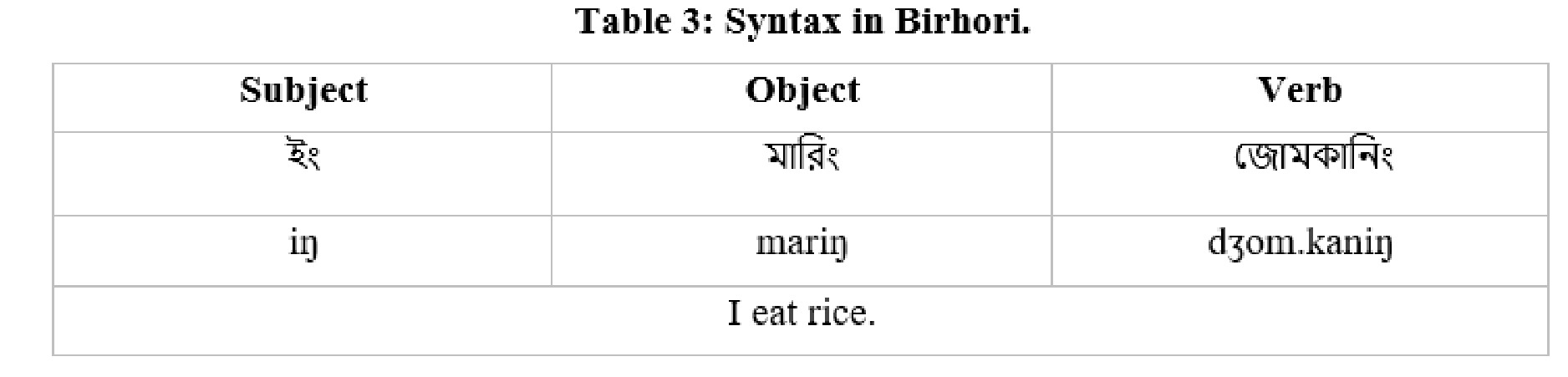
The Birhori language is also spoken in Bihar, Madhya Pradesh, Orissa, West Bengal, Chhattisgarh, and Maharashtra. In West Bengal, the Birhor are a small tribal group. In Purulia, Birhors have a language of their own called Birhori, which appears to have been influenced by Bengali. The Birhors of Purulia are closely related to the Santals and have developed a linguistic connection with them. According to the 2001 census, the population of Birhor was 1017 in West Bengal. The Birhori language has borrowed numerous loanwords from Ho, Santali, Bengali, and Hindi (Sarkar, n.d.). It has no script performed orally. The Birhori language has a Subject-Object-Verb (SOV) word order. The first edition of A Trilingual Dictionary of Birhoɽ, i.e., the Birhoɽ-Hindi-English Dictionary, was published in the year 2022. It has over 4,000 entries with three sections of headwords (Birhoɽ, Hindi, and English). This is the first-ever Birhoɽ dictionary. It contains a vast array of words in Birhor, translated into English and Hindi. Due to a lack of script, it is not used in any schools or mass media.
Grammatical rules
The fieldwork for this study was executed in the Purulia district that was limited to three villages: Bhupatipally, Bahreria, and Bersa. These locations were used to collect and verify data. According to the findings, there was a slight variation in grammar, vocabulary, and accent among speakers in these villages. As a result, we were unable to locate a dialect variation of the Birhor language in the Purulia district. Nevertheless, there could be a linguistic variation of the Birhor spoken in Jharkhand. One of the notable differences includes the way children are called by their surnames; Birhor communities in West Bengal are usually called Sikari or Shikari, whereas the Birhor surname is widely used in Jharkhand. The given paper provides a brief description of the main grammatical peculiarities of the Birhor language. It also describes key elements of its phonology, morphology, and syntax and provides an overview of word construction and sentence patterns in the language.
Vowels and consonants
This paper provides a brief description of the most significant grammatical features of the Birhori language, including its phonology, morphology, and syntax. It provides a review of the linguistic characteristics of the words formed in the language, as well as an overview of sentence structure division. Phonology is a linguistic discipline that specializes in the expressions in the sound systems peculiar to a given language, as opposed to phonetics, which considers speech sounds in a general manner. The speech sounds in the Birhori language consist of both vowel and consonant combinations, a feature common to most languages worldwide. The language supports five vowels, namely /i/ and /e/ (front), /u/ and /o/ (back), and /a/ (central), which are pronounced when there is no obstruction of any type in the vocal tract. Birhori has twenty-three sounds (phonemes) of the consonants (Table 1).
Some International Phonetic Alphabet (IPA) has been used with the English alphabet to present the sound of consonants. The symbol [ɲ] represents the sound equivalent to the English "ny". The symbol [ŋ] represents the sound equivalent to the English "ng". The symbol [ʒ] represents the sound equivalent to the English "sh" and the symbol [ʔ] represents completely stopping airflow in the throat ("Eng (Letter), " 2026) (Table 2).
Syntactic patterns
Like the Austro-Asiatic linguistic trait, Birhori sentence construction involves both a subject and a predicate (Table 3). Typically, Birhor adheres to a Subject-Object-Verb (SOV) syntactic structure. Notably, in pronominal usage, agreement between the verb and the noun phrase (NP) subject is observed-for example:
Sentence types
Based on investigation, it was observed that three different types of sentences are used by people of the Birhor tribe in West Bengal. Some examples are given below (Table 4).
Number system
In the Birhori language, plurality is a grammatical concept denoting two or more entities such as people, places, animals, birds, objects, which is expressed by adding the suffix /-kunʈa/ কু নটা to a singular noun (Tables 5 and 6).
Personal pronoun
There is a prolific role of Infixes and suffixes in Birhori word formation. In this language, to change from a nominative pronoun to an accusative, the suffix -ke and ku are added to the end of the nominative pronoun, and to change the possessive from a nominative, the suffix -na, ana and re are added to the end of the nominative pronoun (Table 7).
Tense system
In Birhor, the structure of the tense is shaped by the number of the subject, reflecting a subject-verb agreement pattern. This means that the tense suffix in Birhor indicates whether the subject is singular or plural. Accordingly, the formation of tense in the language varies based on whether the nominative noun in a sentence or speech is singular or plural. The tense structures in Birhor can be outlined as follows (Table 8).
Festivals and Rituals of Birhor
The Birhor people are economically and socially backward castes who endure great hardship of daily livelihood throughout the year. However, they find relief during festivals, which provide an opportunity to lighten their burdens. Although they do not have their own distinct festivals, they celebrate many types of celebrations throughout the year. Like the tribals, the Birhor express their joy through dance and song during these occasions. Each festival is dedicated to a deity and holds a specific purpose (Table 9).
Additionally, numerous rituals and worship practices are associated with hunting, marriage, birth and death. On all festive occasions, dancing continues around the whole day. They also believe in supernatural spirits (Figure 1). For this reason, they perform much worship out of fear. Birhors are economically engaged in hunting, trapping, rope making, food collection, herbal practice, honey collection, agricultural and labour work (Table 10) (Sahu, 1995).
Extinct Cultural Practices
The Birhor people are a versatile and cultured group of people having their own style and source of activities which is maintained throughout the year, which makes them different from the rest of the tribal groups. Nevertheless, their literacy level is very low and most of these kids drop out of school in the middle of the way. Perhaps, the most remarkable way in their life is the fact that they are not willing to move out of their villages. Consequently, modern influences have made little impact on them, allowing many traditional beliefs to persist. We met several elderly members of the community who possess extensive knowledge of Ayurvedic medicine. They have many cultural practices in common with other tribes of West Bengal. However, some unique traditions that may not survive in the future are explored in the following section (Figure 2).
Monkey eating
Hunting monkeys and consuming their flesh was a distinct cultural practice of the Birhor tribe. Thick and strong vines were brought from the forest, nets were made from that vine, and the people of this primitive tribe used to hunt monkeys with that net. However, since the government imposed various restrictions on hunting monkeys, monkey hunting has ceased nowadays. After the World Life Protection Act was introduced in 1972, regulations were imposed on the hunting of mammals. However, they still hunt small animals, such as rabbits and porcupines (Kriti, 2018). Monkey traps can still be seen in some remote homes. Going hunting is like a festival for them. According to them, they have a mantra given to them by their ancestors, which enables them to trap monkeys in their nets. It is known that a few families still go hunting monkeys and eat their meat. Hunting for these primitive tribes is so intertwined with their lives that they cannot leave it. Most of their surnames, such as Shikaria, have originated from this. Sitaram Shikaria of Bhupatipally said that they do not hunt monkeys now, but their ancestors did. Mostly, they go hunting only during the hunting festival, which is celebrated during Baisakh month.
Rope Making
The Birhor have a reputation as rope makers. Many people know their tribe through this practice. Every Birhor family is well-versed in making ropes (Pagha) to tie up cows (Mitra & Chakrabarti, 2014). Earlier, they used to make this from the bark of a Charlatan tree (Bauhinia scandens), but now the demand for this rope has decreased and it is challenging to collect or find this bark in the forest. Therefore, they now make this rope from threads of plastic bags rather than tree bark. This rope is strong and robust. The Birhor people make this rope that is based explicitly on the coordination of hands and feet. However, the Birhor tribal communities mostly use this rope for their household work. This is also a source of income for them (Figure 3).
Herbal Practices
Like other tribal communities, the Birhor community people also know the applications and usage of traditional Ayurvedic medicine. This primitive tribe is highly skilled in identifying and harvesting the right plants in the forest. Several people were found in the village of Bhupatipalli who collect the bark and roots of Ayurvedic plants. They have enough knowledge on how to use them for various diseases. This is their way of earning a living. However, it is understood that they are forced to do this as they have no other work. They do such kinds of work in extreme poverty. However, the new generation is not interested in maintaining these traditions, so with the passing of these older individuals, this professionalism and special skill will pass into oblivion in no time. This extremely valuable knowledge will also come to an end. During this field work, the knowledge about medicinal plants has been collected from Chunu Sikaria and Bablu Sikaria, who practice Ayurveda and collect the valuable parts of medicinal plants (Table 10).
FINDINGS
The Birhor tribe is a Particularly Vulnerable Tribal Group (PVTG) in West Bengal, which has undergone considerable socio-economic and cultural changes because of the government's rehabilitation campaigns. They are traditionally nomadic forest people, but this scenario has changed as they now live in fixed settlements, altering their traditional forms of work and life. The natural fibre rope-making business, their primary source of livelihood, has been largely phased out by synthetic fibre ropes as the sources have been exhausted. Furthermore, it is a fact that they used to hunt monkeys as part of their tradition, but this practice decreased due to a ban. Nevertheless, some aspects of the tradition remain. Their language, Birhori, is endangered, with declining speakers and no written script, further threatening their cultural identity. Few Birhor people can speak their language fluently.
Most Birhor people are accustomed to the Bengali language. It was thus extremely difficult to collect some words in the Birhori language. They struggle so much with their daily lives that they cannot even think about preserving their language and culture. On this front, there is no concrete practice toward the revitalization of Birhor or its related policy. On the one hand, older generations are still possessive of their inheritance, the Indigenous knowledge of herbal medicine, but on the other hand, the younger people do not seem to care. Despite these challenges, the Birhor people maintain unique cultural traditions, including distinct festivals and social practices, but their survival is at risk due to modernization and economic hardships.
CONCLUSION
The Birhor tribe is standing at a crossroads between modernity and tradition right now. Their economy, language and customs have undergone significant changes because this community, which was previously a nomadic forest community, was forcibly settled on the land, resulting in dramatic socio-cultural transformations. The gradual disappearance of traditional jobs, such as rope-making with natural vigour and monkey-hunting, as well as the decreasing knowledge of this language make Birhor people highly vulnerable to the identity of the inhabiting population. Despite these challenges, this tribe has remained intact with its distinctive forms of culture, including festivals and the use of herbal medicines. However, as younger generations abandon the knowledge of their ancestors, distinguished preventive and conservative measures should be taken right now to ensure the systematic documentation and preservation of their tradition and culture.
Their culture, including the language, way of life and survival, will require government intervention, in addition to communal efforts, to maintain the group. The active work will help the Birhor community to preserve their rich heritage, which is endangered, as well as their unique way of life. Additionally, Tribal social ecology, a significant aspect of social ecology thought, focuses on the relationship between tribes and their environment. It is centered on the social, institutional and cultural background of this relationship to address intricate societal problems. As Mukherjee (2020) highlights, this approach calls for both moral regeneration and, more importantly, social reconstruction along the ecological lines.
ABBREVIATIONS
PVTG: Particularly Vulnerable Tribal Group; PVTGs: Particularly Vulnerable Tribal Groups; SOV: Subject-Object-Verb; IPA: International Phonetic Alphabet; NP: Noun Phrase; IKS: Indian Knowledge System.
CONFLICT OF INTEREST
The authors declare that there is no conflict of interest.